Someone comes into your therapy room for an energy healing session.
They tell you they’re stressed.
Perhaps they’re struggling to sleep. They’re overwhelmed, exhausted or emotional. Maybe they simply tell you that they haven’t felt like themselves for a long time.
Then, during the session, something shifts.
They become tearful.
Their breathing changes.
They suddenly feel uncomfortable being touched.
A memory surfaces.
They freeze.
Or they begin telling you about something painful that happened years ago.
What do you do?
This is one of the reasons I believe trauma-informed training matters for anyone working closely with people, including BioEnergy therapists and other energy practitioners.
Because we’re never simply working with an energy field.
We’re working with a human being.
And every human being who walks through our door brings a lifetime of experiences with them.
What Does Trauma-Informed Mean?
Being trauma-informed does not mean that an energy healer becomes a trauma therapist.
It doesn’t qualify us to diagnose trauma, treat PTSD or replace the work of psychologists, psychotherapists, counsellors, doctors or other appropriately qualified healthcare professionals.
Trauma-informed practice is about how we work with people.
It means understanding that a person may have experienced events or relationships that have affected their sense of safety, trust, choice and control.
And we may know absolutely nothing about those experiences.
A client doesn’t have to tell us their trauma story for us to work in a way that respects that possibility.
That’s the important distinction.
We don’t need to know what happened to someone to treat them with sensitivity, respect and choice.
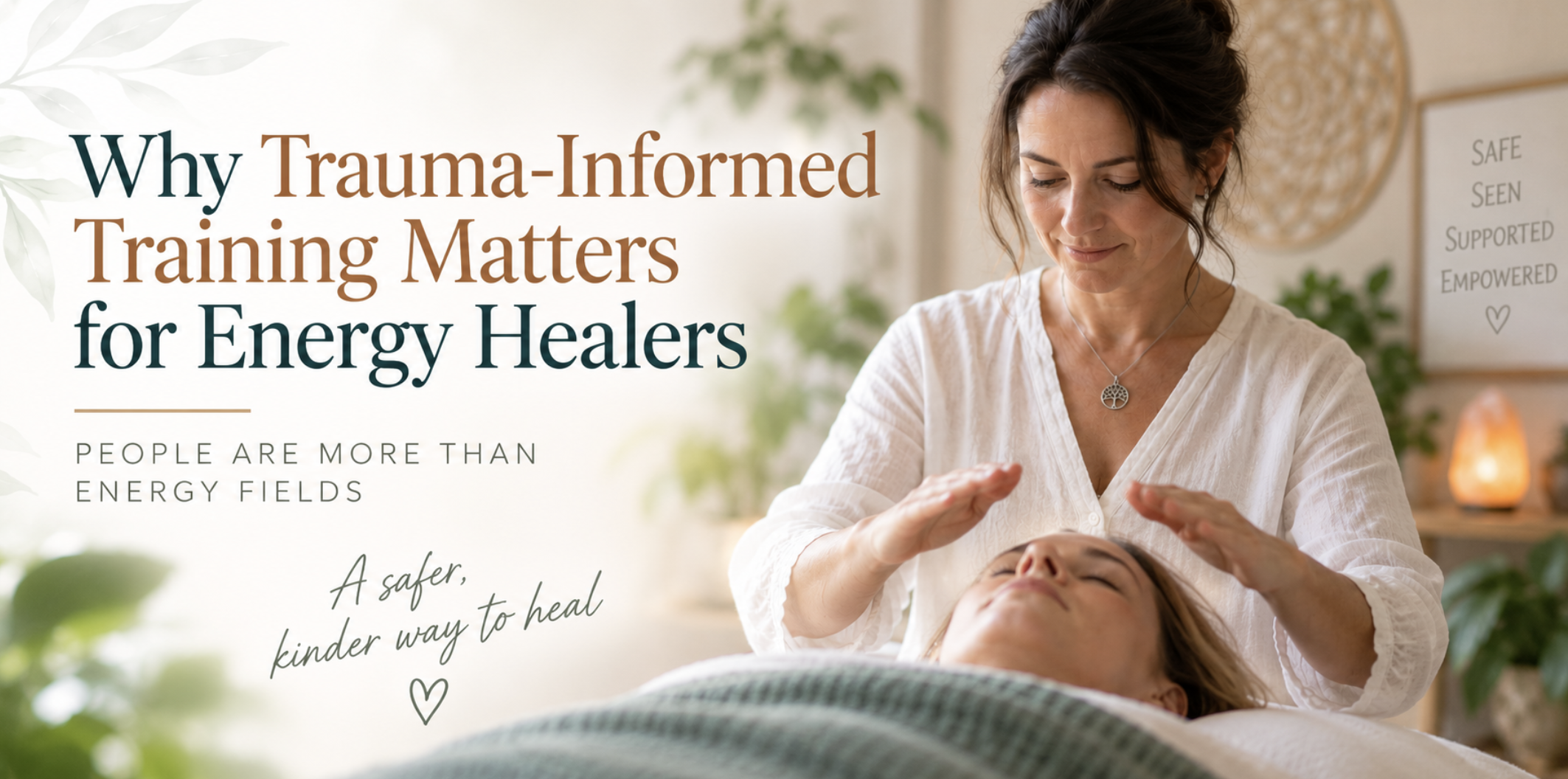
Energy Work Can Be More Intimate Than We Realise
When you’ve worked as a therapist for a long time, certain things can begin to feel completely normal.
Standing close to somebody.
Moving around their body.
Placing hands on or near particular areas.
Closing someone’s eyes or asking them to close theirs.
Working while they’re lying down.
Using particular language.
Creating a quiet environment in which someone becomes deeply relaxed.
But imagine experiencing that through the nervous system of somebody whose personal boundaries have been violated in the past.
Suddenly, something we consider completely ordinary can feel very different.
That doesn’t mean we should be frightened of working with people.
It means we need awareness.
Our intention may be completely safe, but the client’s nervous system doesn’t respond to our intention alone.
This is why consent and communication matter.
Consent Is More Than Getting Someone Onto the Therapy Table
A client agreeing to have a BioEnergy or energy healing session doesn’t mean they’ve automatically consented to everything that might happen during it.
Good consent is ongoing.
Before touching somebody, explain what you’re going to do.
Ask permission.
If you’re going to work close to an area of the body that may feel sensitive or vulnerable, communicate.
Give people options.
And make it clear that they can change their mind.
A simple:
“Are you comfortable with me working here?”
can make an enormous difference.
The client should know they can ask you to stop, move away, change position, keep their eyes open or end the session.
Their body belongs to them.
That sounds obvious.
But in therapeutic spaces, where the practitioner is often perceived as the person who knows what should happen next, clients can sometimes surrender more control than we realise.
A trauma-informed practitioner actively gives that choice back.
You Don’t Need to Know Someone’s Trauma Story
One of the misconceptions about trauma-informed work is that we need to uncover what happened.
We don’t.
In fact, as an energy practitioner, digging for somebody’s trauma story can take us well outside our professional role.
If someone tells me they’ve experienced trauma, I don’t need every detail in order to work respectfully with them.
And if they don’t tell me, I don’t assume there must be trauma hidden somewhere that needs to be discovered.
That’s important.
Not every physical sensation has a buried traumatic memory behind it.
Not every emotional response needs interpretation.
Not every blockage needs a story attached to it.
Sometimes the most respectful thing a practitioner can do is not go looking for something that the client hasn’t asked us to find.
Be Careful With the Stories You Give Clients
This is an area I feel strongly about.
Energy practitioners can sometimes make very definite statements about what they believe is happening in another person’s body or energy field.
“You’re holding trauma here.”
“This came from your childhood.”
“Your relationship with your mother caused this.”
“Your body is releasing abuse.”
Even when said with good intentions, statements like these can carry enormous weight.
The practitioner is in a position of authority.
A vulnerable client may take an interpretation as fact.
That’s why we need to be very careful about the difference between:
what we observe,
what we intuit,
and
what we actually know.
An energetic impression isn’t a medical diagnosis.
An intuition isn’t proof of an event.
And our interpretation of somebody else’s experience should never become more important than their own.
Good practitioners remain curious without becoming certain about things they cannot know.
What Happens When Someone Becomes Emotional During Energy Work?
People sometimes become emotional during complementary therapy.
That isn’t automatically a problem.
Crying doesn’t necessarily mean something has gone wrong.
Nor does it necessarily mean we’ve discovered or “released” a trauma.
Sometimes people cry because they’ve finally stopped.
Sometimes they’re tired.
Sometimes they’re grieving.
Sometimes something has been on their mind all day.
Sometimes they feel deeply relaxed.
And sometimes they don’t know why they’re crying.
We don’t always need to explain it.
One of the most valuable things we can learn as practitioners is how to stay present without immediately trying to fix, interpret or investigate.
You can slow things down.
Check whether the person wants to continue.
Give them time.
Ask what they need.
And if what is emerging requires support outside your professional competence, recognise that too.
Understanding the Nervous System Changes How You Work
Trauma-informed training also gives energy practitioners a basic understanding of nervous system responses.
When the nervous system perceives threat, people can respond in different ways.
They may become agitated or anxious.
They may want to leave.
They may become very still or disconnected.
They may find it difficult to answer questions.
They may suddenly become uncomfortable with something that felt perfectly fine five minutes earlier.
A practitioner who doesn’t understand this might think:
“I’m hitting a powerful energetic blockage.”
A trauma-informed practitioner has another possibility available:
“This person may not feel safe right now. I need to check in.”
That shift in thinking matters.
Because instead of pushing deeper into a technique, we can become more responsive to the person in front of us.
More Intense Doesn’t Mean More Healing
There can sometimes be an assumption in healing spaces that a dramatic session must be a powerful session.
Huge emotional release.
Crying.
Shaking.
Strong physical sensations.
Memories appearing.
But intensity isn’t a measure of therapeutic success.
And as practitioners, we shouldn’t chase dramatic responses because they make us feel that something profound has happened.
A quiet session can be valuable.
A client feeling safe enough to relax can be valuable.
Someone leaving feeling calmer than when they arrived can be valuable.
We don’t need to create a breakthrough every time somebody lies on our therapy table.
Sometimes less is exactly what the person needs.
Trauma-Informed Practice Also Means Knowing Your Scope
Perhaps one of the most professional sentences any therapist can learn is:
“This is outside my scope of practice.”
There is no shame in that.
It’s a sign that you understand your role.
BioEnergy Therapy is a complementary therapy.
Training as a BioEnergy practitioner does not qualify someone to diagnose physical or mental health conditions, advise clients to stop prescribed treatment or medication, or provide psychotherapy or trauma treatment unless they hold separate professional qualifications that allow them to do so.
Sometimes supporting someone responsibly means recognising when they need another kind of professional support.
We don’t have to be everything to everybody.
In fact, trying to be can become dangerous.
Boundaries Protect the Client and the Practitioner
Trauma-informed practice isn’t only about the client’s boundaries.
Practitioners need boundaries too.
When you work with people who are struggling emotionally, it can be very easy to become overly involved.
You may feel responsible for fixing them.
You may allow sessions to continually run over time.
Clients may begin contacting you frequently between appointments.
You might carry their stories home.
You might find yourself thinking about how you can “save” someone.
None of that makes you a more caring therapist.
Clear professional boundaries create a safer relationship for both people.
You can care deeply about somebody’s wellbeing without becoming responsible for their life.
That’s a skill practitioners have to develop.
Why I Include Trauma-Informed Practice in BioEnergy Training
The BioEnergy system I teach through the BioEnergy School of Ireland comes through an established teaching lineage connected with Michael O’Doherty of BioEnergy Healing in Ennis and the foundations of the BioEnergy system.
I value that lineage enormously.
But the world of therapy has also evolved.
Our understanding of trauma, nervous system responses, consent, professional boundaries and therapeutic relationships has developed enormously.
And I believe practitioner education needs to develop with it.
I’ve worked with people through energy therapy, sound therapy, hypnotherapy, coaching and emotional wellbeing for many years.
The more I’ve learned about trauma and the nervous system, the more convinced I’ve become that energy practitioners need this awareness too.
Not because we’re becoming trauma therapists.
Because we’re becoming safer, more responsible practitioners.
That is why somatic and trauma-informed principles form part of the professional BioEnergy Diploma training I teach today.

What Should Trauma-Informed Energy Healing Training Include?
If you’re considering professional energy healing or BioEnergy training, I believe your education should include more than energetic techniques.
You should learn about:
-
informed and ongoing consent
-
professional boundaries
-
scope of practice
-
basic nervous system awareness
-
recognising when a client may be uncomfortable or overwhelmed
-
communicating clearly before and during a session
-
allowing clients choice and control
-
responding appropriately when emotions arise
-
avoiding suggestive interpretations
-
knowing when to stop
-
knowing when to refer someone for other professional support
-
practitioner self-awareness
-
ethical client relationships
These aren’t optional extras around the “real” energy work.
They are part of learning how to work professionally with another human being.
You Can Be Intuitive and Still Be Professional
I love energy work.
I’ve spent a significant part of my professional life working in spaces that aren’t always easily explained by conventional models.
I believe intuition has a place in therapeutic work.
I believe in the energetic system.
And I also believe strongly in professional responsibility.
Those things don’t contradict each other.
You can be deeply intuitive and still ask permission.
You can work energetically and understand your professional limitations.
You can trust what you’re sensing without presenting your interpretation as fact.
You can believe something profound is happening without needing to convince your client of your explanation for it.
And you can work spiritually while remaining grounded in ethics, consent and respect.
For me, that’s where energy healing needs to go.
Becoming a Better Energy Practitioner
Learning more techniques won’t necessarily make you a better practitioner.
Sometimes becoming better means learning when not to use a technique.
It means becoming comfortable saying:
“I don’t know.”
It means noticing the person rather than becoming so focused on the protocol that you miss what’s happening in front of you.
It means understanding that your client has agency.
And it means recognising that the goal isn’t to prove how powerful you are as a healer.
The work isn’t about the practitioner being powerful.
It’s about creating a professional space in which another person feels respected, listened to and safe enough to receive the complementary support they’ve chosen.
That’s why I believe trauma-informed training matters for energy healers.
Not because every client has trauma that needs to be uncovered.
Not because energy healers should become trauma therapists.
But because every person deserves to be treated as a whole human being, not simply an energy field.
Trauma-Informed BioEnergy Practitioner Training in Ireland
Trauma-informed and somatic principles are incorporated into the Diploma in Bio-Energy Therapy at the BioEnergy School of Ireland, alongside practical BioEnergy training, energy systems, established BioEnergy protocols, clinical practice, ethics, case studies and practitioner mentorship.
If you’re considering becoming a professional BioEnergy therapist, you can explore our upcoming Diploma training dates and locations, read the full syllabus, or contact Dee O’Connor, Founder and Lead Trainer of the BioEnergy School of Ireland, to learn more about the training.