If you’re thinking about becoming a BioEnergy therapist, you may be wondering whether you really need to attend an in-person course.
After all, we can learn almost anything online now.
There are online courses for energy healing, Reiki, meditation, coaching and countless other holistic therapies. They’re convenient, often cheaper and can be completed from home.
So why travel to a classroom to learn BioEnergy?
For me, the answer is simple:
You can learn about energy online. But to learn how to work confidently with energy, you need to experience it.
And that’s why I believe professional BioEnergy practitioner training should include substantial in-person, hands-on learning.
Can BioEnergy Be Taught Online?
Parts of it absolutely can.
Online learning can be excellent for understanding theory.
You can learn about:
- the human energy field
- chakras
- meridians
- the aura
- the principles behind BioEnergy Therapy
- emotional wellbeing
- professional ethics
- boundaries
- trauma-informed practice
- practitioner responsibilities
You can watch demonstrations.
You can study diagrams.
You can read protocols.
You can discuss case studies.
We use online learning and Zoom support ourselves at the BioEnergy School of Ireland because there are parts of practitioner education that work very well in that format.
But there comes a point where you have to move away from understanding energy intellectually.
You need to feel it.
Feeling Energy Is Different From Reading About It
This is one of the first things students begin discovering during their practical BioEnergy training.
I can explain an energy field to you.
I can tell you what you might notice when you’re scanning.
I can demonstrate where my hands go.
I can explain the different sensations practitioners sometimes experience.
But eventually I need to say:
“Now you do it.”
That’s where the real learning begins.
You stand in front of another person.
You bring your hands towards their energy field.
You begin scanning.
And you notice something.
Maybe it’s heat.
Maybe it’s cold.
Perhaps there’s tingling in your fingers.
You might feel pressure, resistance, heaviness or a subtle change that you can’t immediately put into words.
Or you might think:
“Dee, I haven’t a clue what I’m supposed to be feeling.”
That’s completely normal too.
Because you’re learning.
How Do You Know You’re Actually Feeling Energy?
This is probably one of the biggest questions new students have.
“How do I know I’m not imagining this?”
And it’s a very reasonable question.
When you first begin developing energy sensitivity, you don’t necessarily know what you’re looking for.
People also experience energy differently.
One student might experience heat very strongly.
Another might notice tingling.
Someone else may sense pressure or resistance.
Another student may experience the difference much more subtly.
There isn’t necessarily one sensation that everybody has to feel.
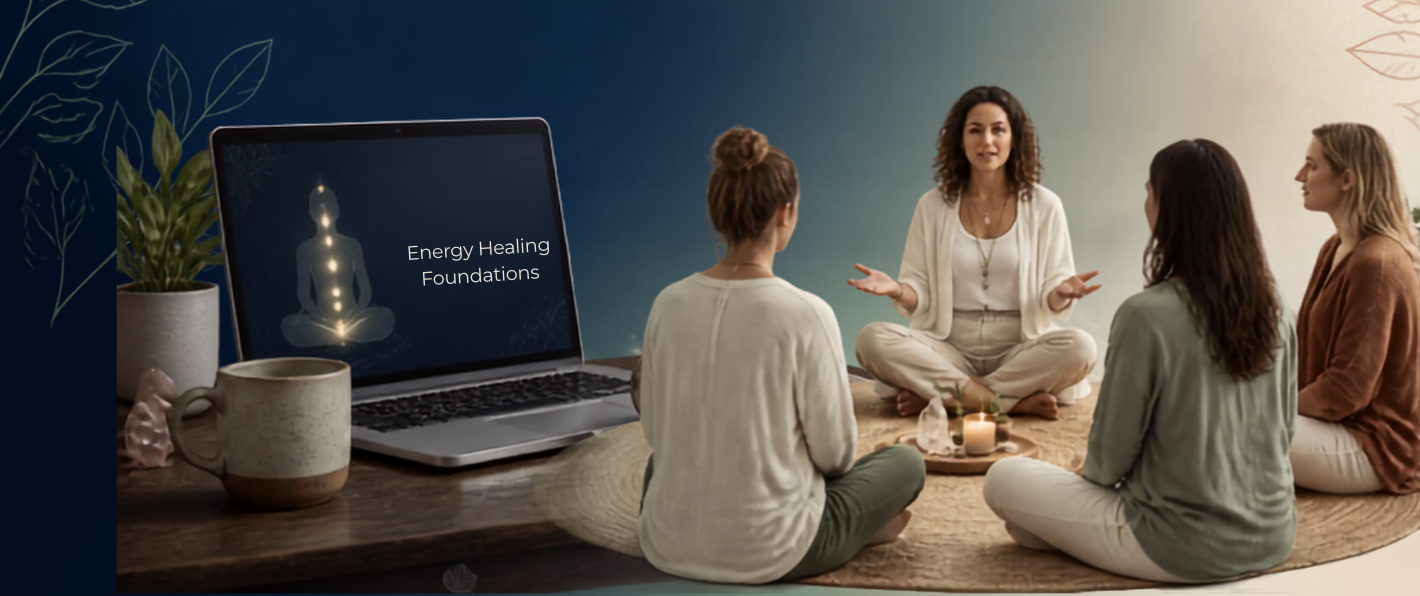
This is where being in a classroom with an experienced teacher becomes incredibly valuable.
You can stop and say:
“I’m feeling something here. Is that what I’m supposed to be noticing?”
We can explore it.
You can move away and come back.
You can practise again.
You can compare what happens when you scan another person.
You gradually begin recognising your own energetic language.
That is much harder to develop when you’re sitting alone at home wondering whether what you’re experiencing is real.
You Need Different Bodies to Learn
Another reason I believe in-person training matters is that everyone feels different.
If you practise only on yourself or one person at home, you have very little to compare.
In a training room, you work with different people.
And suddenly you realise:
Oh. This feels completely different.
The sensation you noticed with one person isn’t present with another.
Something feels stronger in one area.
Someone else’s energy feels completely different again.
You’re building a library of experiences.
That’s incredibly important.
You begin learning that BioEnergy isn’t about memorising what you’re “supposed” to feel.
It’s about developing enough sensitivity and practical experience to notice what is actually happening for you when you’re working.
Learning BioEnergy Is Like Learning Any Practical Skill
Imagine learning massage entirely online.
You could learn the anatomy.
You could watch demonstrations.
You could memorise the movements.
But at some point, you need another human being in front of you.
You need to understand pressure.
Position.
Movement.
Feedback.
You need somebody experienced to observe what you’re doing.
BioEnergy is similar in that respect.
It’s a practical skill.
You can understand the theory perfectly and still feel uncertain the first time you’re standing in front of a real person.
That’s why practice matters.
An Experienced Tutor Can See What You Can’t
When you’re learning something new, you don’t know what you don’t know.
You may be concentrating so hard on remembering a protocol that you don’t notice your position.
You might be rushing.
You may be standing too far away.
You might become fixated on trying to feel something.
Or you might actually be sensing something correctly but dismissing it because you don’t trust yourself yet.
An experienced tutor can observe you.
We can correct something in the moment.
We can ask what you’re noticing.
We can get you to repeat something.
Sometimes I can see that a student has felt something before they’ve even said it.
They stop.
Their expression changes.
Then comes:
“Wait. I felt something there.”
Those are some of my favourite moments in training.
Because suddenly this isn’t something they’ve merely read about anymore.
They’ve experienced it for themselves.
In-Person Training Builds Confidence
Students often think confidence comes from knowing everything.
It doesn’t.
Confidence comes from experience.
You perform a technique once.
Then again.
Then on someone else.
You make mistakes.
You ask questions.
You discover that something you were worried about isn’t actually complicated once you’ve done it.
And eventually you stop thinking through every individual step.
The work starts becoming familiar.
That’s difficult to reproduce through an online-only training programme.
Watching somebody else confidently practise BioEnergy doesn’t automatically make you confident.
You build that confidence by doing it yourself.
What If I Can’t Feel Energy Straight Away?
Don’t panic.
This is precisely why you’re training.
Some students recognise energetic sensations quickly.
Others need more practice.
Neither tells me what kind of practitioner someone will eventually become.
I don’t expect students to arrive at the BioEnergy School of Ireland already knowing how to scan an energy field.
If you could already do everything, you wouldn’t need the course.
Part of my job as your teacher is helping you develop that sensitivity.
We practise.
We compare.
We talk about what you’re experiencing.
And gradually you learn what different energetic sensations feel like for you.
Don’t compare yourself with the person beside you either.
If they’re talking about heat and you’re experiencing tingling, it doesn’t automatically mean one of you is right and the other is wrong.
Your experience is your experience.
Learning to recognise and trust it takes practice.
You Also Learn From Other Students
This is one of the parts of in-person training that’s easy to underestimate.
You don’t only learn from the tutor.
You learn from the room.
Someone asks a question you hadn’t thought of.
Another student describes a sensation you’ve also experienced but couldn’t explain.
You practise together.
You experience being both the practitioner and the recipient.
You compare experiences.
You laugh when something doesn’t go according to plan.
You realise other people are nervous too.
And gradually a group of people who may have arrived feeling uncertain starts developing confidence together.
That shared learning is difficult to recreate in isolation.
What About Learning the BioEnergy Protocols?
The protocols themselves can certainly be written down.
They can be demonstrated in a video.
But knowing the sequence isn’t the same as knowing how to work with a person.
When you’re practising in the classroom, you learn the physical rhythm of the work.
Where you stand.
How you move.
What you’re noticing.
How you respond.
How you communicate with the person receiving the session.
And you receive correction while you’re still learning.
That’s particularly important before you begin your case studies and start working independently.
In-Person Training Also Teaches You How to Work With People
There’s another side to professional BioEnergy training that has nothing to do with whether you can feel energy.
You have to learn how to work with people.
How do you explain what you’re going to do?
When do you ask permission?
How do you maintain boundaries?
What happens if someone becomes emotional?
What if somebody feels uncomfortable?
What if you feel unsure?
How do you stay within your professional scope?
This is one of the reasons trauma-informed and somatic principles form part of the training at the BioEnergy School of Ireland.
Energy work doesn’t happen in isolation.
There’s always another human being involved.
The training room gives you a safe place to learn those practitioner skills before you’re sitting alone with a client.
Does Online Learning Have a Place?
Absolutely.
I’m not anti-online learning.
We use it.
It’s incredibly useful.
Online learning works brilliantly for theory, discussion, revision, mentoring and continued support.
That’s why our BioEnergy Diploma combines in-person practical training with additional learning and Zoom support.
For me, the question isn’t:
Online or in person?
The better question is:
Which parts can be learned effectively online, and which parts need to be experienced in person?
When it comes to actually learning how to sense and work with another person’s energy field, I strongly believe you need the second.
Why the BioEnergy School of Ireland Teaches In Person
Our Diploma in Bio-Energy Therapy includes eight in-person training days because practical experience sits at the heart of how I teach.
Students don’t spend eight days listening to me talk.
You practise.
A lot.
You work with other students.
You experience the techniques yourself.
You learn the BioEnergy protocols.
You develop your sensitivity.
You ask questions as things happen.
You receive feedback and correction.
And then you take that learning into your case studies, where you begin working with different people outside the classroom.
That is followed by continued support and mentorship as you develop.
The goal isn’t simply for you to understand BioEnergy.
I want you to leave knowing what it feels like to actually practise it.
So, Is Online or In-Person BioEnergy Training Better?
If you simply want to learn about energy healing, an online course may give you plenty of interesting information.
But if your goal is to become a BioEnergy therapist and eventually work professionally with other people, I would choose training with a substantial in-person practical component.
Because there is a difference between:
knowing what an energy field is
and
standing in front of another person and recognising what you’re feeling.
There is a difference between:
watching someone perform a BioEnergy protocol
and
being able to perform it confidently yourself.
And there is a difference between:
receiving a certificate
and
feeling ready to work with a real person.
For me, that’s what professional training should ultimately give you.
Train as a BioEnergy Therapist in Ireland
The BioEnergy School of Ireland Diploma in Bio-Energy Therapy, taught by founder and lead trainer Dee O’Connor, combines practical in-person training with theory, case studies, assessments and ongoing mentorship.
No previous experience in BioEnergy or energy healing is required.
You don’t have to arrive already knowing what energy feels like.
You come to learn.
And there’s a moment I see again and again during training.
A student who wasn’t sure they could feel energy suddenly stops during a practical exercise.
They look at me and say:
“Oh my God. I can actually feel that.”
That’s the moment the theory becomes real.
And you can’t get that from simply watching a screen.